
Poitrine de bœuf à la marmite
Rated 3.7 stars by 9 users
Portions
8
Temps de préparation
15 minutes
Temps de cuisson
6
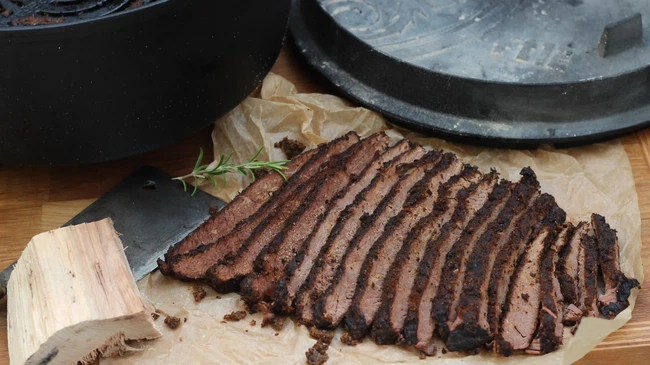
Recette de Beef Brisket au Dutch Oven ! Il faut l’avouer, quand on pense à un Beef Brisket, on imagine une poitrine de bœuf tendre et juteuse cuite au fumoir. Le Dutch Oven montre plutôt ses atouts avec d’autres plats. Mais un Beef Brisket réussit aussi dans le Dutch Oven !
Ingrédients
-
2-3 kg de poitrine de bœuf en un seul morceau
- 1 litre de bouillon de bœuf
-
Pit Powder Beef BBQ-Rub
Préparation
Nous avions un brisket complet Black Angus Full Packer pesant près de 7 kg. En un seul morceau, c’est un peu trop grand pour le Petromax Dutch Oven ft12. Nous l’avons donc découpé en trois morceaux. Le Point a été utilisé pour des Burnt Ends. Comme le Flat était encore trop grand pour le Dutch Oven, nous l’avons partagé et fait du pastrami avec l’autre moitié. La couche de graisse sur la poitrine de bœuf peut être entièrement enlevée ou laissée. Comme la graisse apporte aussi du goût, nous recommandons de laisser une fine couche de graisse sur le brisket. Mais c’est finalement une question de goût. Le Flat restant (environ 2-2,5 kg) est ensuite injecté avec le bouillon de bœuf, puis assaisonné de tous côtés avec le Pit Powder Beef BBQ-Rub et mis sous vide. Ensuite, le brisket est placé toute la nuit au réfrigérateur pour que les épices pénètrent bien.
Même si nous préparons le brisket dans le Dutch Oven, nous ne voulons pas renoncer au goût fumé. C’est pourquoi nous avons d’abord fumé la poitrine de bœuf pendant 2 heures à 110°C dans le Kamado Joe Classic II, un grill en céramique. Pour cela, nous avons réglé le grill en céramique avec des pierres déflectrices pour une chaleur indirecte et placé trois morceaux de Hickory Axtschlag dans les braises, qui apportent l’arôme fumé.
Après 90 minutes, les briquettes pour le Dutch Oven peuvent être allumées. Il faut maintenant 24 Kokoko Eggs. Le reste du bouillon de bœuf est versé dans le Dutch Oven et la grille empilable est placée à l’intérieur. La poitrine de bœuf est ensuite transférée du grill au Dutch Oven et posée sur la grille empilable pour ne pas être directement dans le bouillon. C’est maintenant que le GrillEye Pro Plus entre en jeu : la poitrine de bœuf est équipée d’une sonde de température. La deuxième sonde est placée sur la grille en fonte pour surveiller la température de la chambre de cuisson. Les câbles des sondes sont passés par la gaine et le Dutch Oven est fermé avec son couvercle.
10 briquettes incandescentes sont maintenant placées sous la marmite et les 14 restantes sont réparties sur le couvercle. La température à l'intérieur de la marmite ne doit pas dépasser 150°C. Comme la température dans la marmite dépend toujours un peu des conditions météorologiques et des briquettes utilisées, il peut être nécessaire d'ajuster le nombre de briquettes en les augmentant ou en les diminuant.
Le Beef Brisket a ensuite besoin d'environ 4 heures dans la marmite pour atteindre une température centrale de 90-95°C. Cependant, un brisket doit être cuit en fonction de sa tendreté et pas forcément selon la température centrale. Si vous piquez le brisket avec une sonde de thermomètre ou la pointe d'un couteau et que cela ressemble à traverser du beurre mou, le Beef Brisket est prêt dans la marmite. Selon la taille de la poitrine de bœuf et les conditions ambiantes, le temps de cuisson peut varier. Selon les briquettes utilisées, il peut aussi être nécessaire de rallumer de nouvelles braises. Si vous vous en apercevez à temps, il suffit de placer de nouvelles briquettes à côté des braises encore chaudes. Elles s'enflammeront d'elles-mêmes au contact des briquettes incandescentes.
Si le Beef Brisket est prêt trop tôt dans la marmite, vous pouvez aussi le garder au chaud. Enveloppé dans du papier aluminium et placé avec des bouillottes dans une boîte en polystyrène ou dans un four préchauffé à 60-70 degrés, la viande peut être maintenue au chaud pendant plusieurs heures. On a même l'impression que le brisket est encore meilleur après une heure de repos. Ensuite, il est découpé perpendiculairement aux fibres, badigeonné avec le jus de cuisson de la marmite et servi. Bon appétit et amusez-vous bien à le refaire !


