Fast Shipping 🚚

Weniger Gepäck, mehr Abenteuer: Was beim Camping wirklich mitkommt

Less luggage, more Adventure: What really comes along when camping

• Jörg Wieland

Less luggage, more Adventure: What really comes along when camping

• Jörg Wieland

If you often travel in a motorhome or regularly spend your camping holidays outdoors, you probably know the feeling: At first, you take far too much with you. There’s one item for every conceivable situation that absolutely has to go in the motorhome. After a few trips, things usually look different. Little by little, everything that takes up a lot of space but is hardly used gets thrown out.

Contents

There’s another factor for us: we travel with three dogs. Beds and resting spots, food, leashes, towels, and everything else you need when traveling with dogs already take up plenty of space. So if camping gear is going to stay in our vehicle permanently, it above all has to work.

Not just in theory, but in the morning, when that first coffee is urgently needed. In the evening after a long day by the sea. In the wind. When the dogs come out of the water completely soaked. When nobody really feels like cooking anything elaborate anymore. And also when everything has to be stowed away in the motorhome again the next morning.

Over the years, a few things have emerged that now come along with us as a matter of course.

For us, everything starts with coffee in the morning.

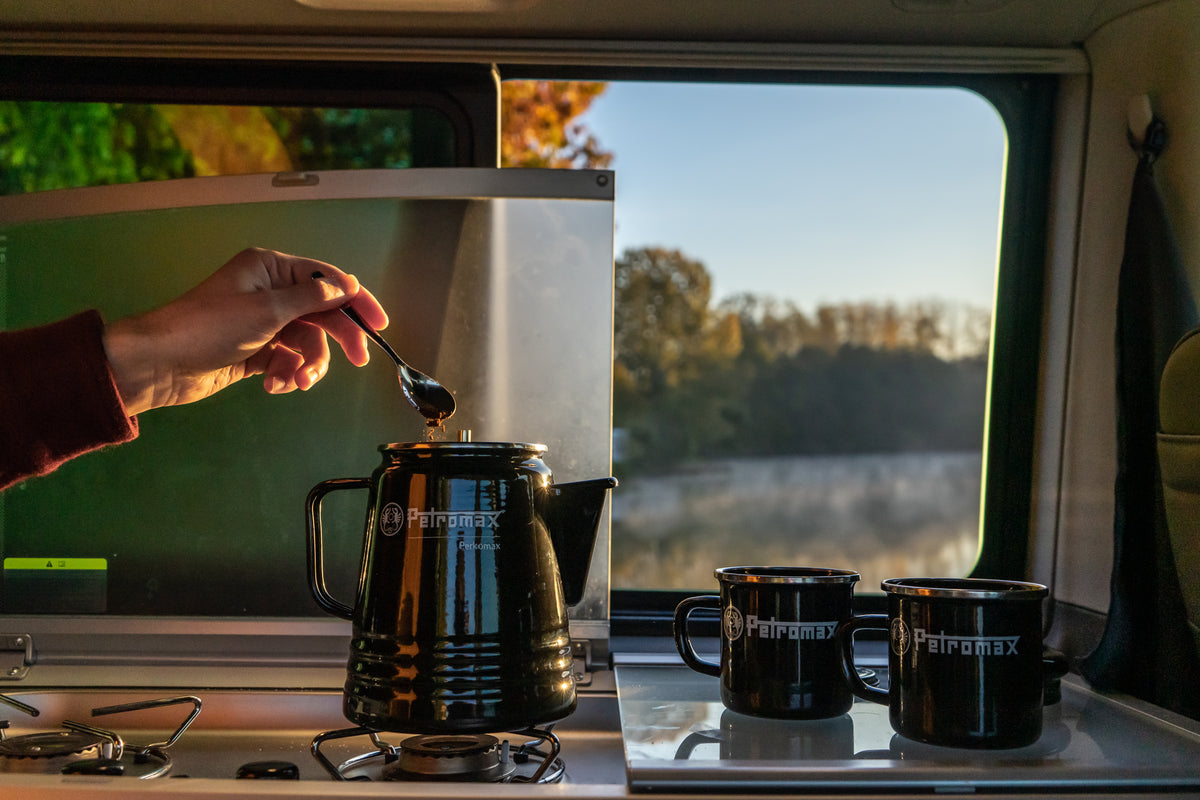
If I could choose just one item from all our gear that I would really miss when camping, the Petromax Percolator would be pretty high on my list.

That’s not because coffee from a percolator looks particularly spectacular. Quite the opposite: the principle is surprisingly simple and fairly old. When heated, the water rises through a tube and then flows back into the pot through the coffee grounds - and not just once. The coffee keeps circulating through the system.

We let our percolator run for about 15 minutes. This brewing method extracts a lot of flavor from the coffee. At the same time, the drink retains the coffee oils that partly get caught in a paper filter when brewing that way. In my opinion, you can clearly taste the difference: the coffee is strong and very aromatic, yet surprisingly well-rounded.

That’s the main difference from regular drip coffee for me.

Of course, you have to experiment a little. The grind size, amount of coffee and brewing time all make a difference. After a few attempts, though, you quickly figure out how you like your coffee best. For us, around 15 minutes has become the standard.

The waiting time has really become part of the ritual: sitting outside the motorhome in the morning while the percolator does its thing, slowly waking up and eventually pouring the first cup. It’s one of those little experiences that, for me, are an essential part of camping.

Of course, I drink coffee at home too. But coffee from the Petromax Percolator outside the motorhome still tastes different.

Maybe it’s the percolator. Maybe it’s the time you take for it. Or maybe it’s simply because you’re looking out at the sea, into a forest or - in the worst-case scenario - at your neighbor’s motorhome.

Either way, it tastes damn good.

Enamel instead of classic camping cookware

With coffee, we use our Petromax enamel mugs, and with meals, the matching plates and bowls.

You still often see melamine dishes at campsites. That’s understandable: they’re lightweight, relatively shatter-resistant and easy to stack. That’s precisely why melamine was considered almost a camping standard for many years.

Even so, I now clearly prefer enamel. The first reason is very simple: to me, it feels more like proper tableware - and less like a practical camping solution.

There’s another aspect, too: melamine dishes can be problematic at high temperatures. The consumer advice centre recommends not using melamine-containing dishes for hot food or drinks such as coffee and soup. At temperatures above around 70 degrees, melamine and formaldehyde can leach from the material and get into the food.

And that’s exactly where it becomes impractical for me when camping. Our plates don’t just hold a cold breakfast sandwich, but also pasta straight from the pot, grilled food, hot sauce or soup. In the morning, I also don’t want to wait for my coffee to cool to a certain temperature before pouring it into the mug.

When eating, I honestly don’t want to have to think about whether something is currently 65 or 75 degrees hot. With enamel, that simply isn’t an issue for us.

Of course, I could also use any old plastic plate. But when we’re sitting outside the motorhome in the evening, having cooked together, with perhaps a bottle of wine or a cold drink on the table, I don’t necessarily want to eat my meal from a plastic plate.

After all, camping doesn’t have to mean going without.

Probably the most unnecessary thing I wouldn't want to be without anymore

Do you need a leather case for your camping cutlery? Of course not. You could just as easily put the fork and knife in a drawer in the motorhome.

Even so, this particular case has become one of the things I especially enjoy using. You roll it open, each piece of cutlery has its place, and after the meal everything disappears neatly back inside.

It’s not a revolution in camping. It’s simply well made.

And for me, it’s precisely these little things that eventually make the difference between “We somehow have everything with us” and camping gear you genuinely enjoy using. Especially when you’re often on the road in a motorhome, you quickly realize how much good organization is worth.

Tip

A wrought-iron pan should be heated as evenly and gradually as possible. Heating a small pan over a flame that is much too large or suddenly heating it at full power can lead to significant temperature differences in the material.

What is cast iron?

Cast iron is made by pouring molten iron into a mold. This process allows for substantial cookware with comparatively thick walls and bases. This makes cast-iron pans, pots and griddles heavier - but at the same time ensures their characteristic heat retention.

Cast iron takes some time to reach the right temperature throughout. Once the material is hot, it releases heat slowly and evenly to the food. This is a decisive advantage for longer cooking times, braising or baking.

Typical uses include:

  • Braised dishes
  • Stews and soups
  • Bread and cakes
  • Casseroles
  • Slow-cooked meat
  • Steaks and burgers
  • Dishes with long cooking times

Cast iron is also particularly versatile in terms of shape. In addition to classic pans, it is used to make Dutch Ovens, loaf pans, griddles, Sandwich Iron and numerous other pieces of equipment for outdoor cooking.

Vorbereitete Mahlzeit in Dimego Campinggeschirr, fertig zum essen beim Camping im Freien

The advantages of cast iron

Cast iron shows its strengths wherever a stable, long-lasting temperature is needed:

  • excellent heat retention
  • gentle and consistent heat
  • ideal for longer cooking times
  • versatile for frying, braising and baking
  • robust and dimensionally stable
  • suitable for grills, stovetops, ovens and open fires
  • durable and free from artificial coatings

Petromax cast iron cookware comes with a so-called seasoned finish. This means it is basically ready to use right away. The patina will continue to develop with further use.

Good to know

The high weight of cast iron is not merely a side effect. The greater mass of the material is one of the reasons why heat can be stored for so long and released evenly.

Wrought iron or cast iron: Which material heats up faster?

Wrought iron usually heats up faster. Since wrought-iron pans are generally made thinner, less material needs to be heated. This allows the energy from the heat source to reach the cooking surface quickly.

This makes wrought iron ideal for short, intense cooking processes. Whether you want to sear a steak, get fried potatoes nice and crispy, or quickly roast vegetables, you don't have to wait long for the right temperature.

Cast iron takes longer to heat up because of its greater material thickness. In return, it loses the stored heat much more slowly. If you place cold food in a well-preheated cast-iron pan, the temperature remains comparatively stable.

The simple rule of thumb

Wrought iron: fast heat, quick response
Cast iron: consistent heat, long heat retention

Gutes Licht macht abends den Unterschied

Ein Produkt, das bei uns ebenfalls erstaunlich häufig zum Einsatz kommt, ist die LM500 LED-Laterne.

Beleuchtung beim Camping klingt zunächst banal – bis man eine Lampe hat, die entweder so dunkel ist, dass man beim Kochen kaum etwas erkennt, oder mit kaltweißem Licht die gemütliche Abendstimmung vor dem Wohnmobil zunichtemacht.

Bei der LM500 lassen sich sowohl die Helligkeit als auch die Lichtfarbe anpassen. Für uns ist das tatsächlich der entscheidende Punkt.

Wenn noch gekocht oder aufgeräumt wird, darf es ruhig etwas heller sein. Wenn die Hunde später auf ihren Plätzen liegen und wir einfach nur noch draußen sitzen, wählen wir ein warmes, deutlich gedimmtes Licht. Das verändert die Atmosphäre komplett.

Und optisch gefällt sie mir ganz einfach auch. Man darf bei Campingausrüstung ruhig zugeben, dass man etwas nicht ausschließlich wegen seiner Funktion mag.

Tip

Pat the meat dry before searing. Moisture on the surface must first evaporate and can delay the formation of a deep crust

Was wirklich mitmuss

Unser Blick auf Campingausrüstung hat sich im Laufe der Jahre verändert. Früher haben wir uns oft gefragt, was wir noch gebrauchen könnten. Heute überlegen wir eher, was wir tatsächlich nutzen.

Denn gerade mit drei Hunden ist Stauraum im Wohnmobil kostbar. Ausrüstung darf deshalb nicht nur praktisch wirken, sondern muss sich im Alltag bewähren.

Das gilt für den Perkolator, weil ich guten Kaffee liebe, genauso wie für unser Emaillegeschirr und das Besteck in der Ledertasche. Die Dimego-Kochausrüstung erleichtert das Kochen und Abwaschen, der Camping-Backofen erweitert unsere Möglichkeiten, und der Atago Gasgrill ist schnell einsatzbereit, wenn es unkompliziert sein soll. Die LM500 sorgt abends für angenehmes Licht und bleibt deshalb oft stundenlang neben uns stehen.

Lebensnotwendig ist davon nichts. Aber Campingausrüstung muss für mich nicht nur das Nötigste leisten. Sie soll dazu beitragen, dass wir unterwegs eine gute Zeit haben.

Wir fahren mit dem Wohnmobil los, weil wir gerne draußen sind, mit unseren Hunden neue Orte entdecken und die Freiheit genießen, morgens irgendwo anders aufzuwachen. Camping bedeutet für mich deshalb nicht, auf möglichst viel zu verzichten. Es bedeutet, die Dinge auszuwählen, die man wirklich braucht – und die das Leben unterwegs ein Stück schöner machen.

Wenn morgens vor dem Wohnmobil der Perkolator läuft, die Hunde noch in ihren Körbchen liegen und der erste Kaffee des Tages richtig gut schmeckt, ist eigentlich schon ziemlich viel richtig gelaufen.

Conclusion: Which is better - wrought iron or cast iron?

Wrought iron and cast iron are classics of outdoor cooking for good reason. Both materials are robust, heat-resistant, and develop a natural patina. Even so, they offer different cooking experiences.

Wrought iron is the right choice for fast, direct heat. The pan heats up quickly, is easy to move, and is especially suitable for steaks, fried potatoes, and quickly sautéed vegetables.

Cast iron excels with long-lasting, consistent heat. It is ideal for large portions, longer cooking times, braised dishes, and baking over the fire.

However, you don't have to choose just one material. In a versatile outdoor kitchen, the two complement each other perfectly: wrought iron handles quick searing, while cast iron retains heat and slowly finishes cooking dishes.

Frequently asked questions about wrought iron and cast iron

Are both materials suitable for an open fire?

Yes. Both wrought iron and cast iron are generally very well suited for grilling, embers and open fires. Always follow the instructions for the specific product and heat the cookware as evenly as possible.

Welches Zubehör sollte ich zusätzlich zum Outdoor Cooking Set mitnehmen?

Neben den in vielen Sets bereits enthaltenen Essentials (Pflegeprodukte, Hitzeschutz) empfiehlt sich folgendes Zubehör: ein stabiles Messer und Schneidebrett, eine zuverlässige Zündquelle für das Feuer, etwas Brennmaterial, falls nicht genügend Holz vor Ort zu finden ist, umweltfreundliches Spülmittel und eine Wasserflasche zum Reinigen. Bei Dunkelheit ist eine Stirnlampe praktisch, und zur Aufbewahrung von Lebensmitteln eignen sich passive Kühlboxen.

Welche Vorteile bietet ein Outdoor Cooking Set im Vergleich zu einzelnen Kochutensilien?

Ein komplettes Set bietet dir mehrere Vorteile: Alle Komponenten sind perfekt aufeinander abgestimmt und ergänzen sich funktional. Du findest genau die richtigen Pflegeprodukte für die jeweiligen Kochutensilien. Zudem ist ein komplettes Set in der Regel günstiger als der Einzelkauf aller Komponenten und erspart dir die zeitaufwändige Suche nach passenden Einzelteilen. Die Komponenten sind außerdem so ausgewählt, dass sie sich ergänzen, ohne unnötige Überschneidungen zu haben.

Wie kann ich beim Packen für den Campingurlaub Platz sparen?

Wähle Campingausrüstung, die sich kompakt verstauen lässt und möglichst vielseitig einsetzbar ist. Ineinanderstapelbare Töpfe, einklappbare Griffe und praktische Aufbewahrungsboxen helfen dir dabei, den vorhandenen Stauraum optimal zu nutzen. Überlege außerdem vor jeder Reise, welche Gegenstände du beim letzten Campingurlaub wirklich gebraucht hast.

Welche Vorteile bietet Emaillegeschirr beim Camping?

Emaillegeschirr eignet sich für heiße und kalte Speisen sowie Getränke und ist eine praktische Alternative zu klassischem Campinggeschirr aus Kunststoff. Ob Kaffee am Morgen, eine warme Suppe oder ein frisch zubereitetes Abendessen – Emailletassen, Teller und Schalen lassen sich vielseitig einsetzen.

Welche Beleuchtung ist für gemütliche Campingabende geeignet?

Eine Campinglampe mit einstellbarer Helligkeit und Lichtfarbe ermöglicht es, die Beleuchtung an unterschiedliche Situationen anzupassen. Die Petromax LM500 LED-Laterne bietet helleres Licht zum Kochen oder Aufräumen und warmes, gedimmtes Licht für entspannte Abende vor dem Wohnmobil.

Petromax Guide Blog

Even more knowledge for your next Adventure

Whether wrought iron, cast iron, Dutch Oven, or cooking over an open fire: In the Petromax guide, you'll find detailed instructions, practical tips, and inspiration for your outdoor kitchen. Find out how to use and care for your equipment properly and get the most out of every Adventure.

Discover the Petromax Guide