
With this rack, you’ll enjoy not only the wonderful roasted flavors but also subtle smoky herbal notes. A spectacular and highly aromatic pork rack awaits you!
Pork loin from burnt hay
Rated 5.0 stars by 1 users
portions
FOR 4 SERVINGS
preparation time
20 Minutes
cooking/baking time
2 Hours
With this rack, you’ll enjoy not only wonderful roasted aromas but also slightly smoky herbal notes. A spectacular and highly aromatic pork rack awaits you!
Ingredients
-
1.2–1.4 kg dry-aged pork rack with a distinct fat cap
-
1 tbsp sea salt
-
1 head of garlic
-
1 handful of Mediterranean herbs (e.g., rosemary, thyme, sage, bay leaf)
-
2–3 tbsp Dijon mustard
-
freshly ground black pepper
-
2 handfuls of organic hay
preparation
Pat the meat dry and score the fat cap at 1 cm intervals. Then season the rack all around with salt, place it fat side down on the grill grate (20–30 cm above the flames), and cook for about 30 minutes. Turn regularly and cook all sides until golden brown. Grill over indirect medium heat at 160–180 °C.
At the same time, place the garlic head at the edge of the embers and cook for 8–10 minutes. Remove from the embers, cover, and let rest for 6–8 minutes. Grill over direct medium heat at 160–180 °C.
Pick through the herbs. Remove 1/3 of the herbs and chop finely. Peel the soft garlic cloves, mash them into a paste, and mix with the herbs.
Line the pan with half the hay and half of the remaining whole herbs. Remove the rack from the grill, let it cool slightly, then rub first with mustard, then with the herb-garlic paste, and season with pepper.
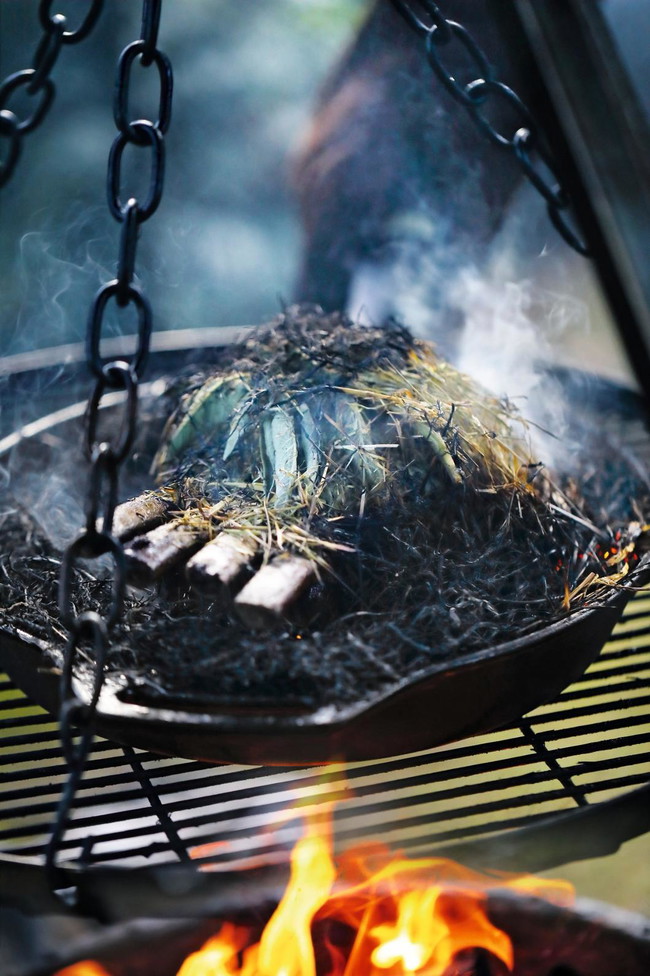
Place the rack in the center of the hay and cover with the remaining herbs and hay. Put the pan on the grill and continue cooking the rack for 1 hour 20 minutes (internal temperature 56–58 °C).
Shortly before the end of cooking, gently ignite the hay with a glowing piece of wood or ember and let it burn off. Remove the hay before serving and let the meat rest for 6–8 minutes without heat.
- Tip: For a wonderfully mild, smoky result, let the ignited hay smolder slowly. If you don’t like that, you can spray the hay with water so it only serves as an aromatic dome that keeps the meat warm from above and retains the heat.
Recipe note
Manuel Weyer, Draussen zusammen am Feuer, 978-3-7589-0248-2, Gräfe und Unzer Verlag in der Verlagsgruppe HarperCollins Deutschland GmbH


